Two-Minute Drill
How to play
You coach one team through the last minutes of a real NFL game. Every snap you pick a play and a tempo; the clock only moves when the ball does. Finish the fourth quarter ahead to win. This guide takes about five minutes.
Your first game in one screen
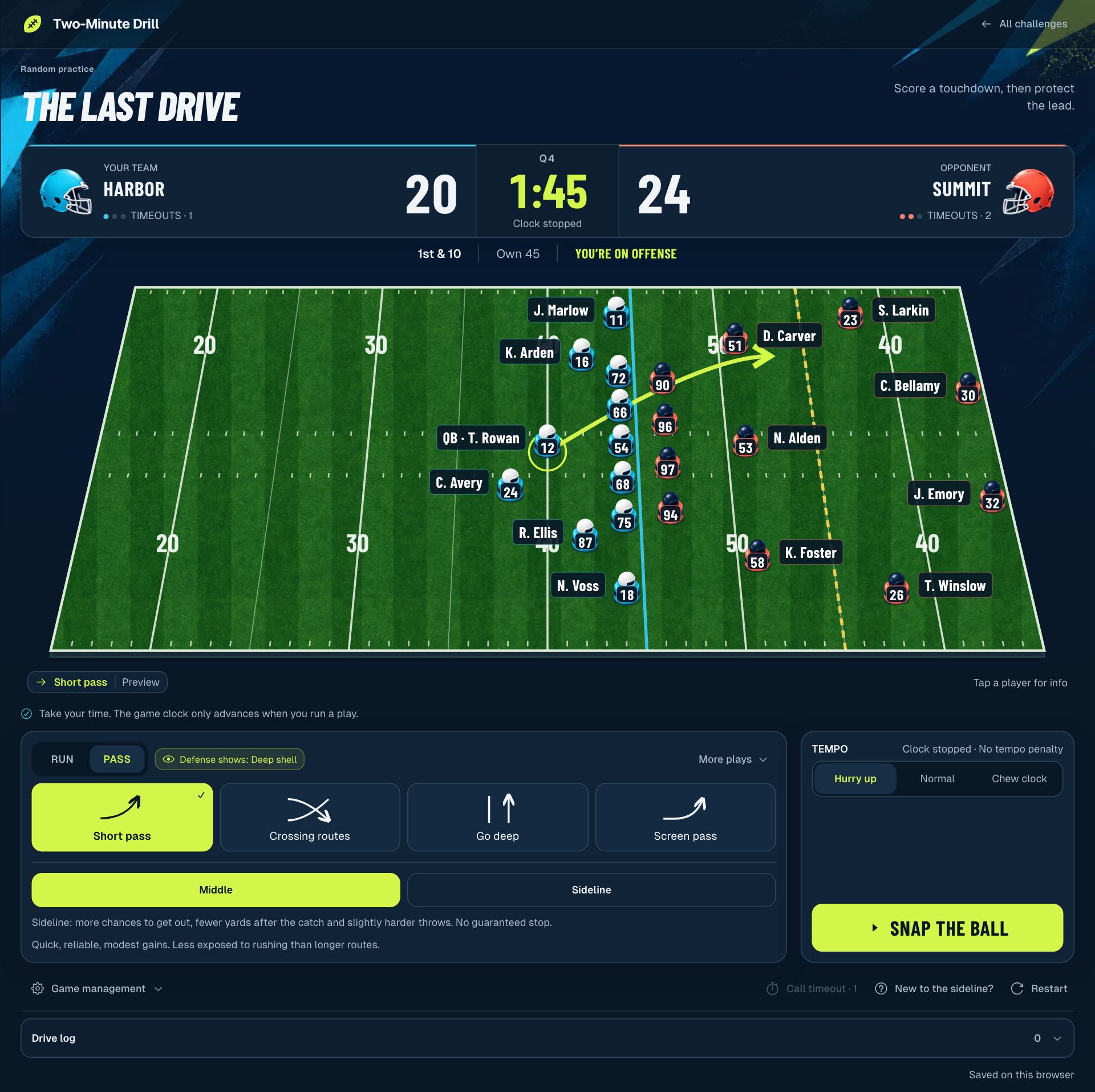
This is the match screen. The numbers match the list below; read it once, then try a warm-up play.
- 1
Scoreboard and clock
Your team is on the left. Below each name: timeouts left. Under the clock: whether it is running or stopped.
- 2
Down, distance and field position
“1st & 10 · Own 45” means first of four tries, 10 yards to gain, ball on your own 45.
- 3
The lines on the field
Blue line: where the ball is snapped. Yellow dashed line: the first-down line. Cross it for a fresh set of downs.
- 4
What the defense shows
A hint about the defense’s plan before the snap. It is usually right, but defenses can disguise.
- 5
Pick a play
Switch between Run and Pass, open More plays for the rest. The note under the cards explains the selected play.
- 6
Where to throw
On passes, Sideline gets out of bounds more often (stopping the clock) at a small cost in completions.
- 7
Tempo
How long you take before the snap when the clock is running. It does not matter after a stoppage.
- 8
Snap the ball
The play runs on the field, then the result and your decision review appear. Take as long as you like before this; thinking is free.
- 9
Game management
Timeout, spike, kneel, field goal and punt live here. “New to the sideline?” opens a quick help card.
Football basics in one minute
New to American football? This is all you need for this game.
- Downs
- You get four tries (downs) to gain 10 yards. Gain them and you get a new first down. Fail on fourth down and the other team takes over, so on fourth down you usually kick instead.
- Field position
- “Own 30” is 30 yards from your own end zone; “Opp 20” is 20 yards from scoring. The red zone is inside the opponent’s 20.
- Scoring
- Touchdown: 6 points, then a kick for 1 or a two-point try. Field goal: 3 points. Safety: 2 points for the defense.
- Field goals
- The kick travels about 17 yards more than the distance to the goal line, so from the opponent’s 35 it is a 52-yarder. Longer kicks miss more.
- Turnovers
- An interception or lost fumble gives the ball away immediately. So does failing on fourth down.
- What stops the clock
- An incomplete pass, a player going out of bounds, a timeout, a spike, a score, a change of possession, a penalty, and the two-minute warning. A run or catch in bounds keeps it running.
- Penalties
- A flag is thrown on about 6% of snaps, as in real late fourth quarters, and replaces the play. Offensive fouls cost yards and the down is replayed. Defensive holding, pass interference, roughing the passer and personal fouls give an automatic first down; pass interference is spotted where it happened, up to the 1-yard line.
Every play you can call
Each call changes the odds, not the outcome: any play can work or fail. These are the same descriptions you see in the game.
Runs
- Inside run
- A steady ground option. Keeps the clock moving.
- Outside run
- More room, more risk. A chance to get out of bounds.
- QB sneak
- Reliable for one yard, capped at three. Limited payoff on longer downs.
Passes
- Short pass
- Quick, reliable, modest gains. Less exposed to rushing than longer routes.
- Crossing routes
- Attack the middle for a first down. Watch the clock.
- Go deep
- Big yards, lower completion odds and more turnover risk.
- Screen pass
- Fastest release and fewer sacks. Safer catches, but less yardage and possible losses.
- Play action
- Bigger gains against a loaded box. Slower release, more sacks; pass coverage can spoil it.
Clock and kicks
- Timeout
- Stop a running clock without using a down.
- Spike
- Rush to the line in 9s, then spike in 1s. Uses a down; ignores tempo.
- Kneel
- Lose one yard, use a down and keep the clock running.
- Field goal
- Take a shot at three points. Longer kicks are less reliable.
- Punt
- Give up possession and push the opponent back.
On defense
- Stop the run
- Crowd the box. Give up more space through the air.
- Stay balanced
- Cover both options without committing to either.
- Protect the pass
- Make completions harder. Leave room on the ground.
- Blitz
- Extra pressure and more sacks. Quick throws and screens can punish it.
- Protect deep
- Deny the big play, concede short gains and runs. Useful when only a touchdown beats you.
After a touchdown and on kickoffs
- Kick for one
- A high-probability kick for one point.
- Go for two
- A higher-risk attempt for two points.
- Kick deep
- Most kicks are returned, to about the 31 and using around 6s; a touchback gives Summit the 35.
- Onside kick
- 7.5% recovery chance. Use 3 seconds; failure gives Summit the ball near midfield.
Where to throw
- Middle · Sideline
- Sideline: more chances to get out, fewer yards after the catch and slightly harder throws. No guaranteed stop.
Reading the defense
Before each snap on offense the defense shows one of four looks. Pick plays that attack what it shows, but expect an occasional disguise.
- Loaded box
- Eight or more near the line. Runs get harder; play action and deep shots can hit.
- Light box
- Two safeties deep. Room to run; quick passes meet coverage.
- Showing blitz
- Pressure is likely, or it is a bluff. Screens and quick throws beat a real blitz.
- Deep shell
- Safeties bail deep. Underneath throws and runs are open; deep shots are not.
Clock math: how many plays do you have?
Most two-minute drills are lost to the clock, not the defense. What one snap costs depends on whether the clock is running:
| After the play | Time it costs |
|---|---|
| Run or catch in bounds (clock keeps running) | The play (about 4–7s) plus the wait before the next snap: Hurry 16s, Normal 31s, Chew 38s |
| Incomplete pass or out of bounds | Only the play itself; the clock waits for the next snap |
| Timeout | Nothing, and the clock stops |
| Spike | About 10s, and it uses a down |
| Accepted penalty | The play’s time if a play ran, otherwise none; the clock then waits for the snap |
Example: 1:00 left, no timeouts. In-bounds plays at Hurry cost about 22s each, so only two or three fit. Plays that stop the clock cost about 6s, so around ten fit. That is why trailing teams throw to the sideline and save timeouts.
Winning habits
Trailing on offense
- Know your number: down 1–3, a field goal ties or wins; down 4–8, you need a touchdown.
- While the clock runs, use Hurry. After a stoppage the tempo costs nothing extra, so any choice is fine.
- Get out of bounds: sideline throws and outside runs stop the clock more often.
- Keep a timeout for the end. It saves a down that a spike would cost and can set up a last field goal.
- Spike only when the clock is running and you have no timeout left.
- If a field goal wins it, run the clock down first so the other team cannot answer.
Protecting a lead with the ball
- Run and stay in bounds with Chew: every snap costs the opponent time.
- Kneel when the math works: each kneel uses a down and, with the clock running, up to 40s.
- Avoid risky throws. A turnover hands them the ball and the clock.
- A first down is worth more than yards: it is four more snaps of clock.
On defense
- When only a touchdown beats you, Protect deep: concede short gains, not the end zone.
- Short completions in bounds help you when the clock is running.
- A blitz is a gamble: more sacks, but screens and quick throws beat it.
- If you are trailing, your timeouts stop their clock so you get the ball back with time.
After a touchdown
- Kick for one in most cases. Go for two when two points tie the game or make it a field-goal game and one does not.
- Trailing late, an onside kick (recovered about 7.5% of the time) can buy one more possession.
How your calls are graded
After each snap the game replays your exact situation thousands of times with every sensible alternative and compares the average results. The decision score (0–100) averages how close each call was to the best option: 100 means every call was near the best, 90 is about a 0.5-point win-probability gap per call, and 70 about 2 points.
Each call gets one of three grades. Luck is shown separately: a good call can fail and a poor one can work, so the grade judges the decision, not the outcome. When the best choice depends on how the next plays are called, the review says so.
- Estimated near best
- Small estimated gap
- Larger estimated gap
Ways to play
Every UTC day brings three daily challenges: chase the win, protect the lead and control the finish. Everyone starts each one from the same seed, and your first attempt at each counts; replays are practice.
You can also play 711 historical situations from the 2022–2025 seasons, nine practice challenges, a fresh random situation, a win streak, and the home page warm-up.
Rules that differ from real football
There is no overtime: a tie at 0:00 stays a tie. Team and player strength are not modeled, so every team gets league-typical results. Penalties are simplified: accepted fouls replace the play and declined fouls are not shown.
Where the numbers come from
Play results, clock use, kicking, kickoffs and penalty rates are measured from nflverse play-by-play data (2022–2024 seasons, checked against 2025). About 6% of snaps draw an accepted flag, as in real late fourth quarters.
Where to start
Play the warm-up on the home page first; it never counts. Then try the two starter challenges, Backs to the wall and Hold the line. When you are ready, take on the three daily challenges: your first start of each one counts.